Nothing to buy. Nothing to plan.
Most couples who say "we should do yoga together" never do. Not because they don't want to, but because the idea arrives wrapped in preparation. You need a class. You need matching mats. You need to find a free evening and a teacher and some courage.
You need none of that. A bare patch of floor, a rug or a towel, and about fifteen minutes is enough. This guide gives you seven partner poses that beginners can do at home tonight, with plain instructions and no jargon you have to look up first.
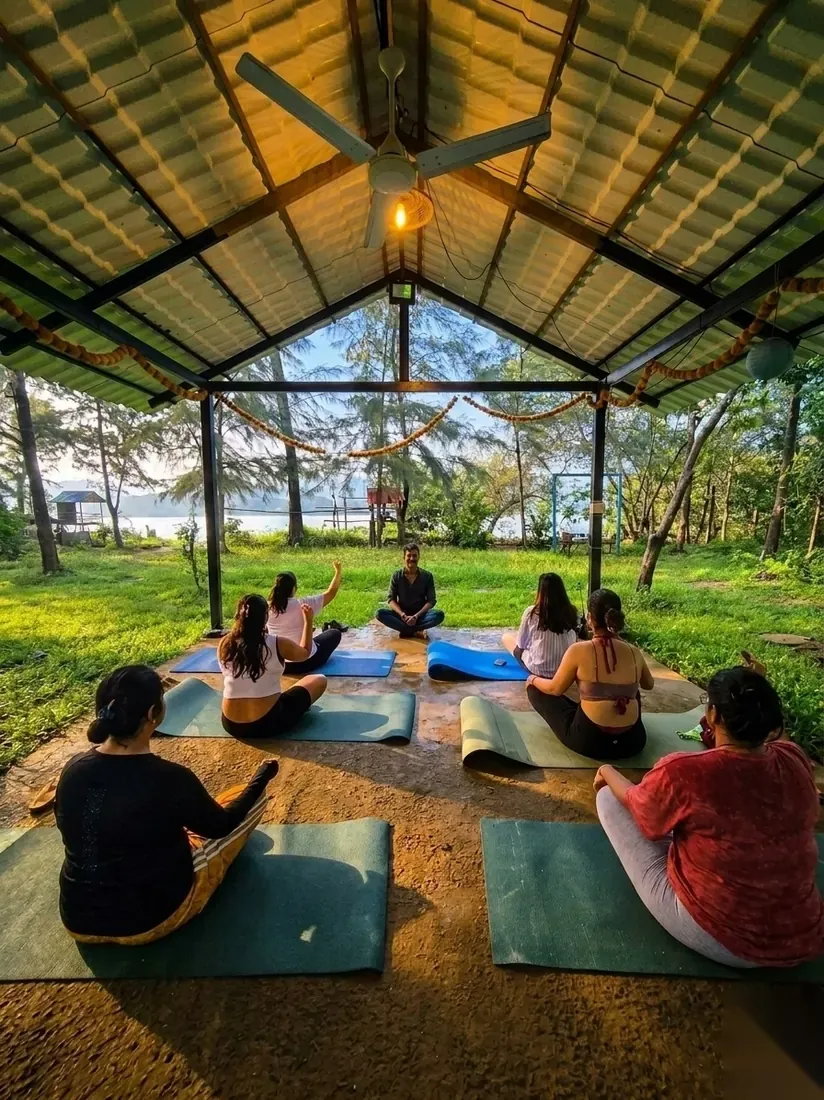
We teach these practices on Sai Island in Goa. The poses themselves are simple. What changes things is that two people who usually move side by side through the day, each absorbed in their own screen or task, are suddenly facing the same direction on purpose, breathing at the same time, and relying on each other's weight.
Why partner yoga feels different from solo yoga
When you practise alone, you only answer to yourself. You can drift, rush or quietly skip the hard part. Partner yoga removes that option in a gentle way. If you lean back, your partner has to lean forward. If you hold your breath, they feel it. The pose only works when both people pay attention.
That is the real benefit for a couple. You are not trying to look good in a pose. You are practising noticing each other, adjusting, and trusting. These are the same small skills that long relationships run on, and they are easy to lose when life becomes a schedule.
There is also a lighter side. Partner poses are slightly funny. You will wobble. You will laugh. Many couples find that laughter in the first five minutes does more for the mood in the room than any amount of planning a romantic evening.
What you need: nothing
This is the principle we keep returning to. You do not need to buy, book or plan anything.
- A clear patch of floor about two metres square
- Comfortable clothes you can move in
- Bare feet
- Fifteen minutes and your phone switched to silent and left in another room
If the floor is hard, fold a blanket or use a rug. That is the whole kit list.
Agree on three things before you begin
Take thirty seconds to agree:
- Either of you can say "stop" at any time, and the other will stop without a discussion.
- Nothing should hurt. Mild stretching is fine. Sharp, pinching or electric sensations mean back off.
- No scoring. You are not trying to do it right. You are trying to do it together.
Pose 1: Back-to-back seated breathing
Sit on the floor back to back, legs crossed or stretched out in whatever way is comfortable. Let your spines rest against each other. Place your hands on your own knees.
Close your eyes and take five slow breaths. Try to feel your partner's back rise and fall against yours. You do not have to match them. Just notice. After a few breaths, many couples find their breathing starts to line up on its own.
This is the best opening pose because it asks for nothing except stillness. It also settles the nervous energy that makes the first few minutes feel awkward.
Pose 2: Seated forward fold with held hands
Sit facing each other with your legs open in a wide V, feet touching your partner's feet or ankles. Hold each other's forearms or hands.
One person leans back slightly while the other folds forward from the hips, using the hold to gently draw the folding partner forward. Stay for five breaths, then swap.
Go slowly. The one leaning back is not pulling, only offering a steady anchor. If the folding partner's back rounds, that is fine. Aim for length rather than depth, and stop at a comfortable stretch through the backs of the legs.
Pose 3: Seated twist back to back
Sit back to back again with legs crossed. On an inhale, sit tall. On an exhale, each of you twists to your right, placing your left hand on your right knee and your right hand on your partner's left knee.
Hold for five breaths, looking over your shoulder if your neck is comfortable. Come back to centre on an inhale and repeat on the other side.
Because you are using each other as a gentle anchor, many people find they can twist a little further than alone. Keep it modest. Twisting is meant to feel like wringing out a cloth softly, not a wrestling match.
Pose 4: Partner tree
Stand side by side, a hand's width apart. Place your inside hands on each other's shoulders or around each other's waists. Shift your weight onto your outside foot.
Bring the sole of your inside foot to your calf or the inside of your thigh. Avoid the knee joint itself. Press the foot and leg together and lift your outside arms overhead if balance allows.
Wobbling is the point. The two of you hold each other up, and when one wobbles the other steadies. Stay for five to eight breaths, then switch sides. If balancing on one leg is difficult, keep the toes of the lifted foot on the floor.
Pose 5: Back-to-back chair
Stand back to back with your heels about a foot away from each other, leaning into each other's backs. Slowly bend your knees and slide down as if you were sitting into an invisible chair.
Walk your feet out a little if you need to, until your thighs are heading toward parallel with the floor. Hold for three to five breaths, then slowly press back up together.
This one needs honest communication. If you slide down faster than your partner, the pose collapses. You have to go at the speed of the slower person. That is a small lesson that tends to stay in the body.
Pose 6: Mirrored warrior
Stand facing each other about an arm's length apart. Step one foot back, turn your back foot out, and bend your front knee so you are in a long lunge. Your partner mirrors you with the matching leg.
Extend your arms out to the sides, palms up, and join fingertips or hands with your partner in the middle. Hold for five breaths looking into each other's eyes or at a point just past your partner's shoulder if direct eye contact feels like too much at first.
Switch to the other leg and repeat.
Pose 7: Child's pose with a hand on the back
Come to your hands and knees and sit your hips back toward your heels, forehead on the floor and arms stretched forward or resting beside you. Your partner kneels beside you and places one hand flat on your upper back.
They do nothing else. No rubbing, no fixing. Just a warm, steady hand. After five to ten breaths, swap places.
Being held without being asked for anything is rarer than it should be, and this pose gives it to each of you in turn.
A simple ten-minute order
You do not have to do all seven. A good order is:
- Back-to-back seated breathing (two minutes)
- Seated forward fold (two minutes, both directions)
- Seated twist (two minutes)
- Partner tree (two minutes)
- Child's pose with a hand on the back (two minutes)
If you have more time, add the chair and the mirrored warrior in the middle. Finish by lying side by side on your backs for a minute of quiet.
Common beginner mistakes
Competing. Partner yoga is not about who is more flexible. If one of you is stiff, the practice is to adjust to them. See our guide to partner yoga when one of you is stiffer than the other for ways to do that.
Talking through every pose. A little coaching is fine. Constant commentary pulls you out of the experience. Try the whole sequence in near silence.
Holding your breath. If you notice yourself doing it, return to slow breathing. It is the quickest way to tell whether a pose is too much.
Forcing depth. Partner poses make it easy to push each other further than you would go alone. Always go to the lesser of the two edges.
Stopping when it feels awkward. The first few minutes are almost always awkward. Stay with it.
A seven-day starter plan
If you'd like a gentle way to build the habit, here is a simple week. Each day takes ten to fifteen minutes.
- Day 1: Back-to-back seated breathing, five minutes. Nothing else.
- Day 2: Seated forward fold with held hands, then back-to-back breathing.
- Day 3: Rest, or take a short walk together.
- Day 4: Seated twist and partner tree, five breaths on each side.
- Day 5: Back-to-back chair, mostly for the laughter.
- Day 6: Mirrored warrior on both sides, then child's pose with a hand on the back.
- Day 7: Your favourite three poses from the week, in the order you like, finished by lying side by side in quiet.
Notice which poses each of you looks forward to. They are a quiet clue to what you need from each other. One of you might love the supported child's pose while the other prefers the mirrored warrior. That difference is worth talking about, kindly, over tea.
Practising in a small space
You don't need a large room. Every pose here can be done in a space about the size of a double bed. If furniture is in the way, push it back, or do the seated poses on the bed itself. For standing poses, a doorway-width of clear floor is usually enough. Put a non-slip rug under bare feet if the floor is polished, and avoid practising on very slippery surfaces or in socks.
How to know it's going well
Good partner practice has a few quiet signs. You laugh at least once. You each speak up about something, a pressure or a pace. You move more slowly at the end than at the start. You feel a little more at ease in each other's company. None of this requires a perfect pose. If you notice these things, you are doing it right, however the poses look.
Frequently asked questions
Do we need yoga experience to try couple yoga poses?
No. Every pose in this guide is designed for beginners, and you can modify any of them to be gentler. If a pose feels like too much, do a smaller version or simply sit together and breathe.
How often should we practise partner yoga?
Twice a week for fifteen minutes is a good starting rhythm. Short and regular tends to work better than one long session you dread. Many couples settle into a favourite sequence they can do without thinking.
What if one of us is much more flexible than the other?
Work at the pace and range of the less flexible partner. The more flexible one can help by offering steadier support rather than going deeper. The practice is about connection, not depth.
Is couple yoga only for couples who are already getting along?
It can help in either case. Moving together in a low-pressure way gives you something shared to do that is not a conversation. On a difficult day, even five minutes of back-to-back breathing can change the mood in the room.
Keep going
A quiet invitation
Want a guided version, just the two of you?
Private one, two and three-day couples retreats on Sai Island, led by Arnold. Tell us about the two of you and which format interests you.
Ask about a couples retreatThese practices are shared as experience and are not medical or therapeutic advice. If you are unsure about anything, speak with a qualified professional.