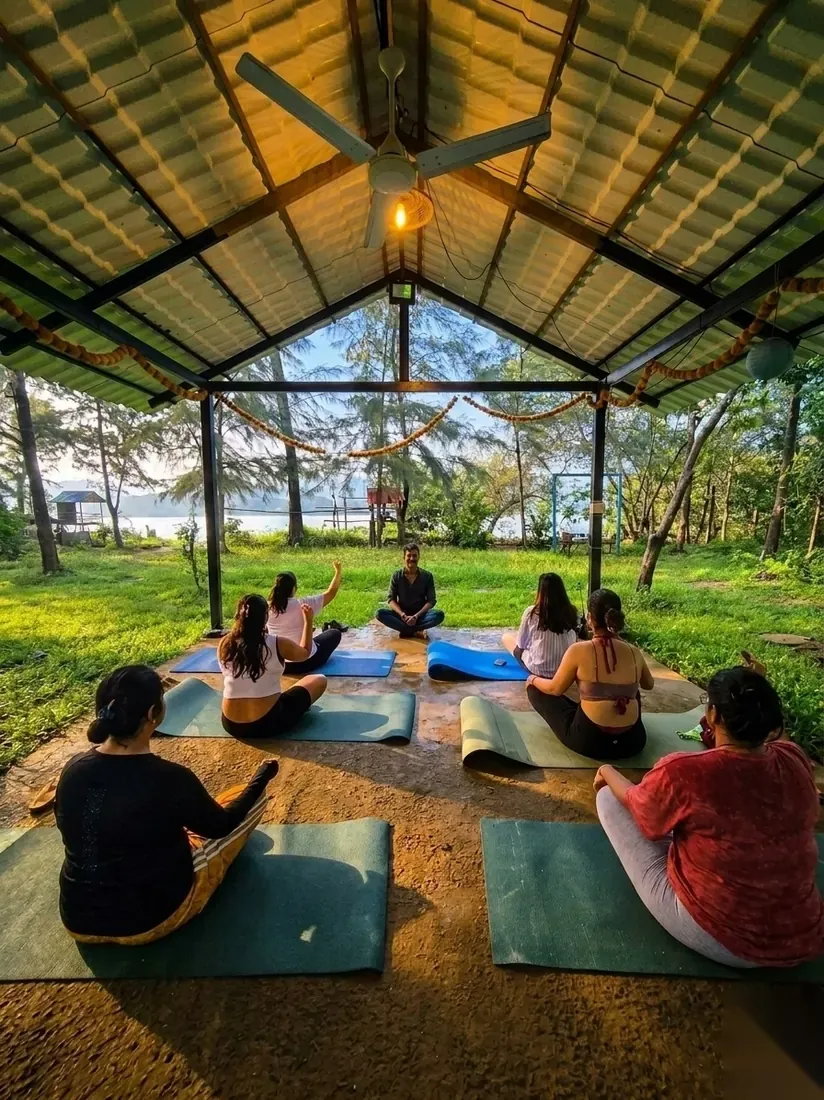
The short answer: arrival day is calm by design. You cross to the island by boat, find your tent, settle in and meet the group over meals. There is no demanding session waiting for you. If you are picturing back-to-back classes the moment you step off the boat, recalibrate: day one is built around arriving, not diving in.
The sequence, step by step
Getting there. You travel through Mopa airport and onward to the mainland near Siolim, with transport arranged by the team once your seat is confirmed. The final stage is a short boat transfer to Sai Island. Our guide on how to reach Sai Island covers the route.
Settling in. On the island there is no immediate session. You find your tent, unpack and orient yourself. Accommodation is a shared tent by default, with private tent and hut upgrades available if you have chosen one.
Meeting the group. Meals are where the group starts to meet. Vegetarian meals, with vegan options, are shared, and first-day conversations tend to be quieter and more observational as people read the room. That is normal and shifts quickly.
A first practice, depending on timing. Depending on when you arrive, the first formal session may be a gentle grounding practice or an orientation to the days ahead, rather than anything as intense as Kundalini activation. The heavier sessions are introduced progressively over the following days.
The rough shape of the day
Exact timings depend on when you arrive and on the cycle, so treat this as a general shape rather than a fixed schedule. Earlier arrivals have a relaxed stretch to unpack and explore, followed by a shared meal. Later arrivals may go straight from the boat to settling in and an evening meal. In both cases the evening is typically low-key, perhaps an orientation, a short grounding practice, or simply time to sit with the group before an early night.
If you have joined mid-cycle, as 5-day and 3-day guests do, you may arrive to find the group already familiar with each other. This is a normal and welcoming part of the format, and people tend to make space quickly.
Why the first day is gentler
Most people arrive carrying mental noise: a full inbox, an unfinished conversation, the general static of ordinary life. That does not switch off the moment you cross the water. The first day, and often part of the second, is when it gradually quiets, whether or not anything formal is happening. The voluntary phone-off culture helps, but it is a process, not an instant. This is also why the 5-day and 7-day formats can feel different from the 3-day: there is more time on the far side of that adjustment. Our comparison of 3, 5 and 7 days explains the structure.
Small things that make day one easier
Bring a few essentials within reach rather than buried at the bottom of your bag: water, a light layer, insect repellent and a headlamp. Eat when meals are offered even if you are tired. Introduce yourself to a couple of people early, since the first names are the hardest. And resist the urge to judge the whole retreat by the first evening, because the energy builds over the following days.
What is expected of you on day one
Nothing, beyond showing up. There is no test of commitment and no requirement to take part fully from the first hour. If you prefer to spend the first afternoon by the water instead of joining a session, that is a perfectly normal way to begin.
A realistic checklist for the day
- Expect a quieter, lower-intensity day than you might picture
- Eat, hydrate and rest, especially after a long journey
- Use unstructured time to settle rather than rushing to get started
- Don't worry if conversation feels slow at first. It opens up quickly.
- Keep a light layer, a torch or headlamp and insect repellent to hand for the evening
- Save your energy and curiosity for sessions that build over the following days
Our packing list covers what to have in your bag.
Who might find it unsettling
- People who dislike unstructured time. If that is you, the call with the team before booking is a good time to ask how the first afternoon runs.
- Anyone who arrives very late or very tired. Tell the team in advance so they can adjust expectations.
- Solo travellers who worry about meeting people. Our article on attending a retreat alone is a useful read.
What comes next
The following days build gradually, with sunrise yoga, breathwork, chakra cleansing, Kundalini activation and sound healing offered progressively, all optional. Everyone converges on the Full Moon finale. The first day is not the retreat holding back; it is the retreat working as designed.
How booking works
Booking is invitation-led. You request an invitation, a seat is held for 24 to 48 hours, you have a call where you can ask about your arrival day, and a deposit then confirms your place.
Frequently asked questions
Is there a session on arrival day?
Possibly a gentle grounding practice or orientation, depending on your arrival time. Nothing intense.
Do I have to attend everything from day one?
No. Every session is optional.
What if I arrive late?
Tell the team early so they can plan transport and settling in.
Will I have phone signal?
Do not count on it. Plan to be mostly offline.
What should I bring on day one?
Comfortable clothes, a light layer, a headlamp and a water bottle.
Next step
Want the full day-by-day structure before you go? See what each retreat length includes.
Practice With Us
Take the practice to the island
Short guided days on our private island near Siolim, Goa. Pick your preferred dates, or book a private session for your group.
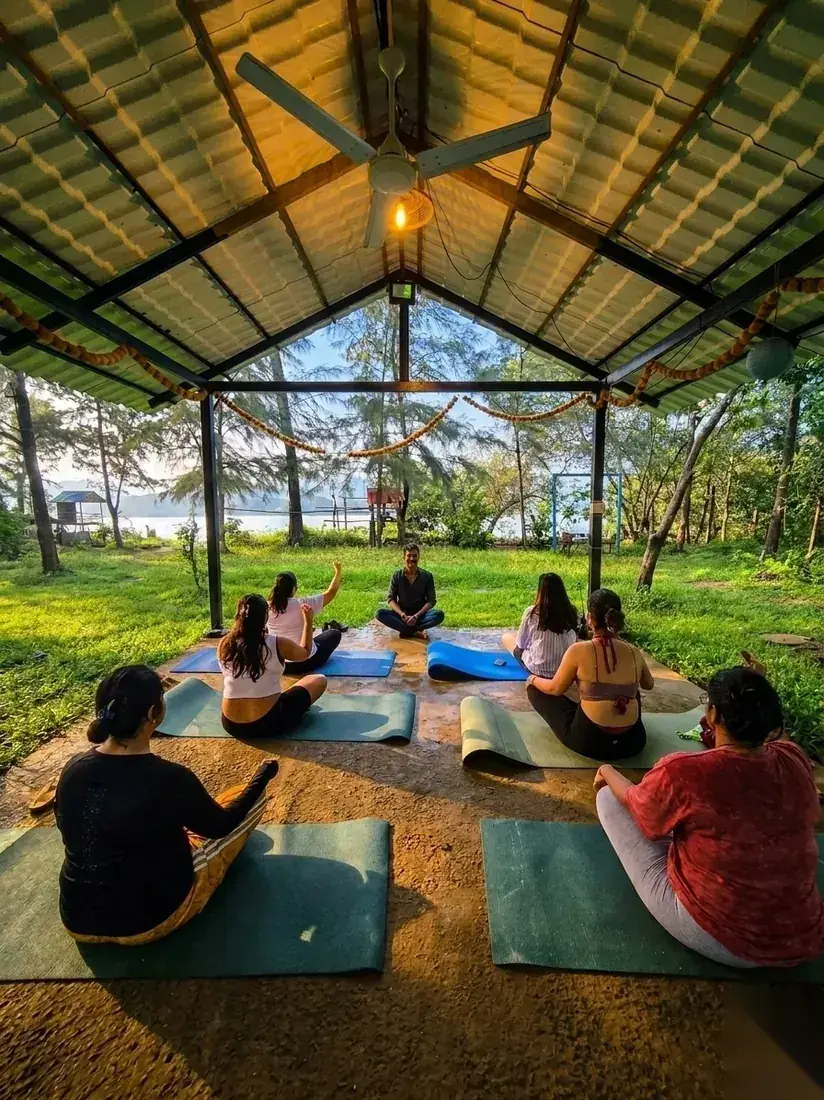
Morning Yoga and Island Breakfast
7:30 am to 10 am · ₹2,222 per person
Begin the day with breath, movement, and a nourishing island breakfast.
See details & book →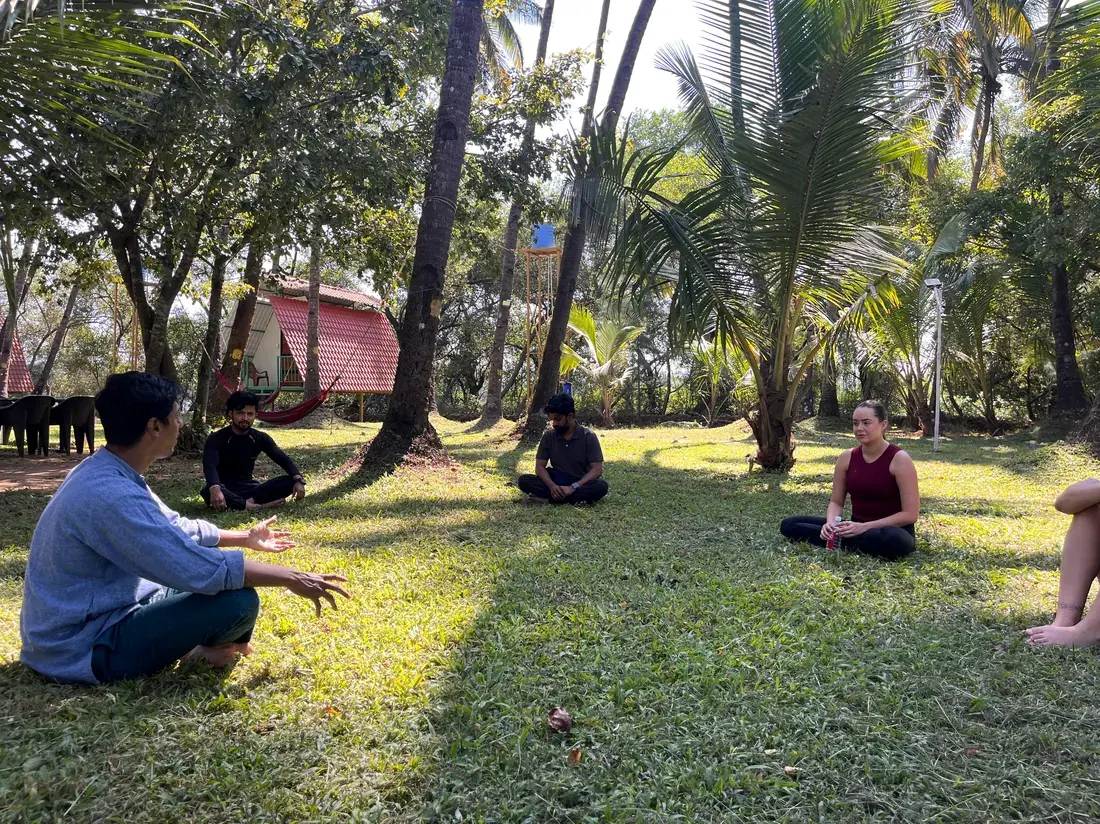
Full-Day Chakra Reset
10 am to 6 pm · ₹5,555 per person
A full day to move energy, soften the mind, and celebrate being alive.
See details & book →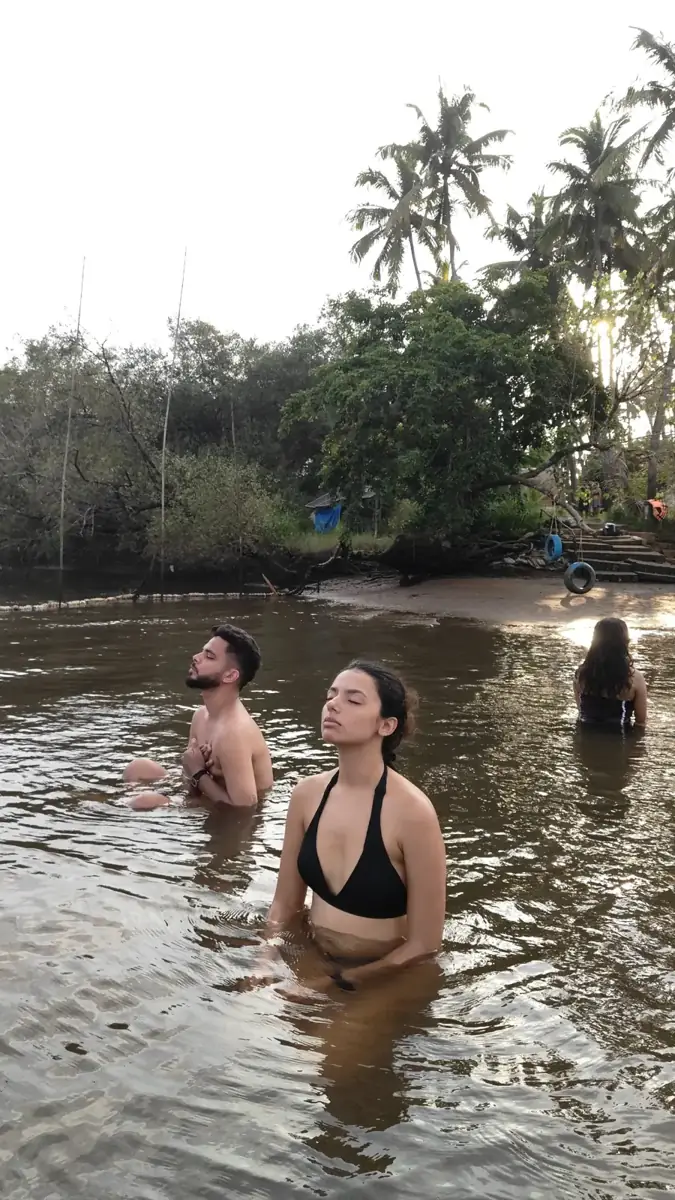
Island Breathwork Reset
4 pm to 7 pm · ₹4,444 per person
Breathe deeper. Slow down. Come back to yourself.
See details & book →